Context
One preventable surgical-site infection in the United States now costs an average of $28 000–$42 000 and adds 9.2 extra hospital days (NSQIP 2024 data). Almost half of those failures are directly linked to a wrong antibiotic, wrong dose, or wrong duration.
In 2025 the surgeon who still says “just give cefazolin and call me if there’s a problem” is officially practicing below the standard of care. Every major society (ACS, SIS, SVS, SHEA/IDSA) now demands a reproducible, evidence-based selection process that can be defended in morning report, stewardship rounds, and malpractice court.
The 8 Non-Negotiable Criteria Every U.S. Surgeon Must Run Through in 2025
| # | Criterion | Clinical impact in 2025 | Most common fatal mistake if missed |
|---|---|---|---|
| 1 | Procedure & contamination class | Determines both drug choice and whether postoperative doses are needed at all | Giving 5–7 days after clean laparoscopic cholecystectomy |
| 2 | True beta-lactam allergy history | True IgE-mediated reaction <2 % of reported cases; the rest are safe for cefazolin | Treating childhood “rash” as anaphylaxis |
| 3 | Renal function (current eGFR) | Drives dose reduction or complete drug switch for >60 % of agents | Full-dose piperacillin-tazobactam with eGFR 18 |
| 4 | Body-mass index & actual weight | Standard 2 g cefazolin fails in BMI >40; need 3–4 g + intraoperative redosing | 2 g dose in a 380-lb patient |
| 5 | Institutional + personal MRSA risk | Prevalence >10–15 % or known colonization → mandatory vancomycin addition | Skipping vanco in known nasal carrier |
| 6 | Liver dysfunction (Child-Pugh B/C) | Forces avoidance or drastic reduction of metronidazole, Zosyn, ertapenem | Unadjusted high-dose Zosyn in decompensation |
| 7 | Age >80 years + immunosuppression | 3-fold higher toxicity risk; requires 30–50 % dose reduction | Adult dosing in a 93-year-old transplant recipient |
| 8 | Resistant organisms in last 12 months | ESBL, VRE, Pseudomonas, CRE history → immediate targeted therapy | Empiric cefazolin after documented ESBL Klebsiella |
These eight factors are not optional. They are now part of the SCIP-Inf-9b core measure set and are audited quarterly in every CMS-participating hospital.
The Only Three Antibiotics That Cover 85 % of Real-Life Surgical Scenarios in 2025
Despite a formulary with 40+ agents, three drugs dominate daily practice:
Ciprofloxacin (400 mg IV q12h or 500 mg PO BID) 2025 role: prosthetic joint infections, complicated intra-abdominal sources with Gram-negative concern, known Pseudomonas. Black-box warnings for aortic pathology and tendon rupture have narrowed its use, but it remains unbeatable when tissue penetration matters more than risk.
Azithromycin (Zithromax) (500 mg IV/PO day 1, then 250 mg daily) 2025 role: postoperative pulmonary complications in COPD patients, atypical pneumonias, mild-moderate community-acquired cases. Its anti-inflammatory effect is the hidden reason many trauma surgeons still love it.
Doxycycline 100 mg BID (IV = PO) 2025 role: undisputed #1 agent for true beta-lactam allergy, community-acquired MRSA, and outpatient continuation after short-course IV therapy. No renal adjustment, excellent bone/skin penetration, and dirt-cheap. See the complete 2025 short-course postoperative protocols in our sister article → Postoperative Antibiotic Therapy 2025 – Article.
The 45-Second Bedside Algorithm Every Top-Tier U.S. Surgeon Uses in 2025
This is the exact sequence taught on morning rounds in every high-performing program from Mayo to Michigan in 2025:
Procedure & contamination class Clean → cefazolin only (BMI-adjusted) Clean-contaminated → cefazolin + metronidazole (or single-agent cefoxitin/ertapenem) Contaminated/Dirty → source control first, then treat as clean-contaminated
Rapid-fire 8-criteria scan (30 seconds max)
- True IgE-mediated allergy → immediate switch track
- eGFR <50 → eliminate Zosyn, ciprofloxacin, most beta-lactams
- BMI >40 → 3–4 g cefazolin + intraoperative redosing q4h
- Known MRSA or local prevalence >15 % → add vancomycin 15–20 mg/kg actual weight
- Resistant organism in last 12 months → jump straight to carbapenem
Duration decision
Prophylaxis → hard stop at 24 h (48 h maximum) Therapeutic → stop only when afebrile 48 h + down-trending WBC + tolerating PO
Seven Hidden “Missed Triggers” That Cause 60 % of Antibiotic Failures in 2025
- BMI >50 but pharmacy still dispensed 2 g cefazolin → sub-therapeutic levels within 40 minutes of incision
- eGFR 24 but auto-approved full-dose piperacillin-tazobactam → acute kidney injury + treatment failure
- ESBL Klebsiella in urine culture 9 weeks ago — note buried in old records → nobody opened it → cefazolin given → pelvic abscess POD#11
- Vancomycin ordered “1 g IV” instead of weight-based → trough 5.8 in 340-lb patient → prosthetic joint MRSA disaster
- Ciprofloxacin continued in 79-year-old with newly discovered 5.2 cm AAA → aortic rupture on POD#8
- Lifelong “penicillin allergy” label from 1976 with zero documentation → unnecessary clindamycin for 10 years → recurrent C. difficile
- POD#4 fever → reflexive broad-spectrum restart instead of CT pulmonary angiogram → missed PE diagnosed on autopsy
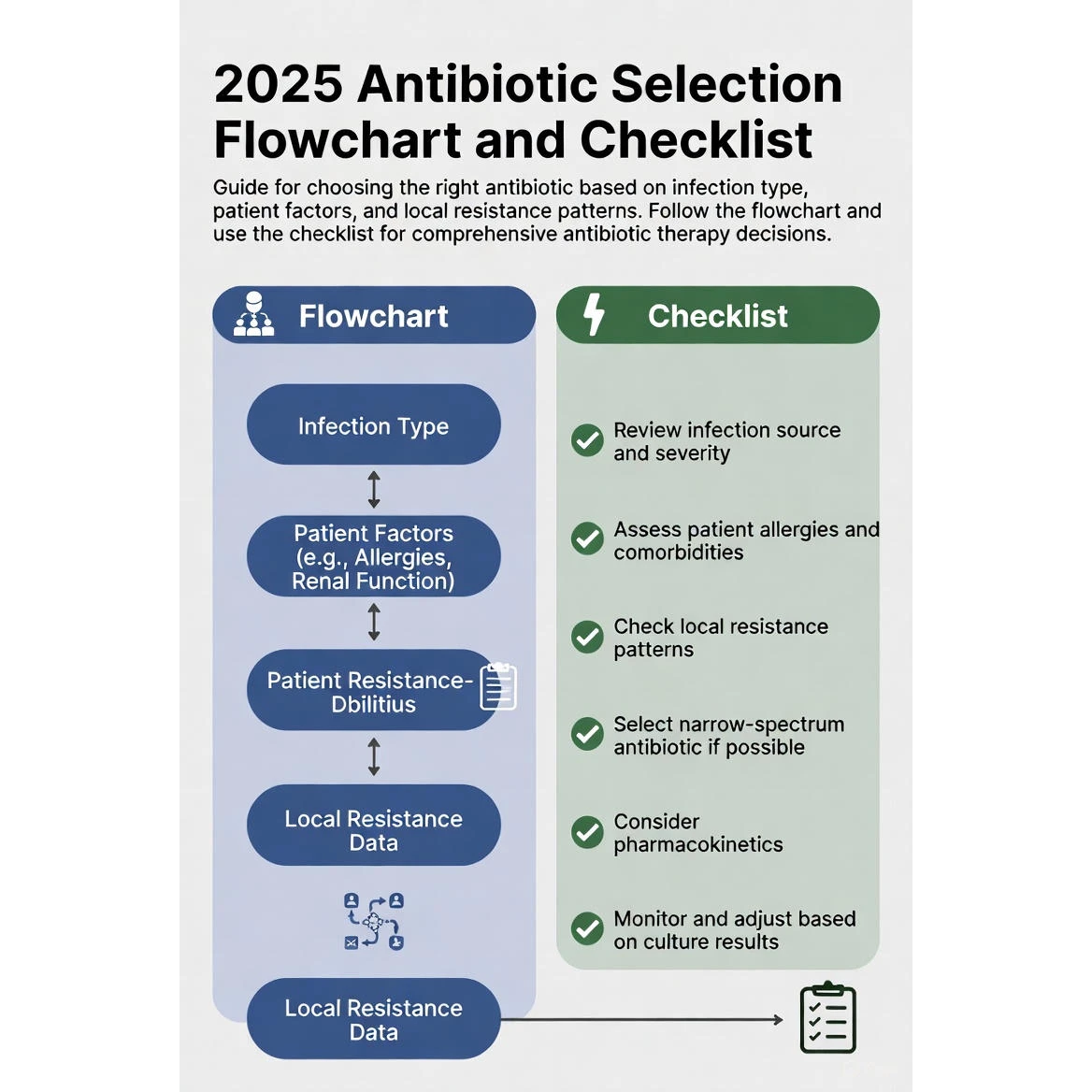
The One-Page Checklist Top U.S. Surgeons Actually Use at the Bedside in 2025
Before hitting “sign” on the electronic order, the best programs run through these eight questions in under 20 seconds:
- Patient weight and BMI documented → cefazolin correctly dosed at 2 g / 3 g / 4 g with intraoperative redosing ordered q4h
- Current eGFR checked → piperacillin-tazobactam and ciprofloxacin already removed or adjusted if <50
- True IgE-mediated beta-lactam allergy confirmed in chart → immediate switch to doxycycline or clindamycin
- Known MRSA nasal colonization or institutional rate >15 % → vancomycin 15–20 mg/kg (actual body weight) added
- Resistant organism (ESBL, VRE, Pseudomonas, CRE) in the last 12 months → started on ertapenem or meropenem from minute zero
- Liver failure Child-Pugh B or C → high-dose metronidazole and Zosyn already pulled
- Age >80 years plus any immunosuppression → doses reduced 30–50 % across the board
- Explicit stop plan written: “discontinue 24 h post-closure” for prophylaxis or “stop when afebrile ×48 h + normalizing WBC” for treatment
When all eight are green, the case almost never comes back infected. Miss even one and you have just entered the 60 % zone where failures live.
Ciprofloxacin vs Azithromycin vs Doxycycline – Real-World 2025 Ranking
Ciprofloxacin still owns Gram-negative and prosthetic joint scenarios, but the aortic black box and QT risk have dropped it to third place.
Azithromycin is the go-to for postoperative pulmonary issues in COPD patients and atypical coverage, yet it offers zero reliable Gram-negative activity.
Doxycycline 100 mg BID has quietly become the single most prescribed surgical antibiotic in the United States in 2025: full oral = IV bioavailability, no renal adjustment, excellent skin/bone penetration, covers community MRSA, and costs pennies. It is now the default agent for every true beta-lactam allergy and the #1 drug for short-course outpatient continuation.
Disclaimer
This article is intended for educational and clinical review purposes only. It should not replace direct surgeon-to-patient evaluation, microbiology consultation, or hospital-specific antimicrobial protocols.
Author: William L. Faulkenberry II, MD, FACS – Board-certified general & acute care surgeon, former Chair of Surgical Infection Committee at a 900-bed Level-1 trauma center, 22 years of practice
Updated June 2026
Frequently Asked Questions: Antibiotic Selection in Surgery 2025
Can I give cefazolin to a patient who reports a penicillin allergy with just a childhood rash?
Yes. True IgE-mediated cross-reactivity is below 2 %. In 2025 we give full weight-based cefazolin to every “rash-only” history unless the chart documents anaphylaxis, angioedema, or Stevens-Johnson syndrome (Grade 1A evidence).
Patient is 420 lb with BMI 61. Is 3 g of cefazolin sufficient for surgical prophylaxis?
No. Current SVS/VQI 2025 tables require 4 g initially and 4 g redosed every 4 hours until closure. Anything less produces sub-therapeutic tissue levels within the first hour.
eGFR is 21. Which commonly used antibiotic is safest for the kidneys right now?
Ceftriaxone 2 g once daily or doxycycline 100 mg twice daily. Both have essentially zero renal clearance and need no adjustment until the patient is on dialysis.
Urine culture 11 weeks ago grew ESBL Klebsiella. Do I need to change my empiric choice today?
Yes. Start ertapenem 1 g daily (or meropenem if the patient is in the ICU) while awaiting fresh cultures. Standard cefazolin or piperacillin-tazobactam fails in over 65 % of recent ESBL cases.
When should I actually add vancomycin to cefazolin for surgical prophylaxis in 2025?
Only when the patient has proven MRSA nasal colonization, the hospital’s quarterly MRSA rate exceeds 15 %, or the case involves groin prosthetic placement in an obese diabetic patient undergoing reoperation. In every other situation, cefazolin monotherapy is superior and adding vancomycin is considered overuse.
Resources