





























Medical Disclaimer
This material is educational and not a substitute for medical diagnosis or prescription. Antibiotics must be prescribed only by a licensed physician after direct clinical assessment. Self-medication can cause severe health complications, antibiotic resistance, and treatment failure.
Author: William L. Faulkenberry II, MD, FACS Board-Certified General and Vascular Surgeon, Fellow of the American College of Surgeons 25+ years of clinical experience, former Chief of Surgery at Level I Trauma Center
The Growing Threat of Surgical Site Infections in 2025 – Latest CDC Data
Surgical site infections (SSIs) remain one of the most common and costly healthcare-associated infections in the United States. According to the Centers for Disease Control and Prevention (CDC) National Healthcare Safety Network (NHSN) report released in January 2025, covering data collected throughout 2024:
- Overall SSI rate across all procedure types rose to 3.1 % in 2024 (up from 2.6 % in 2022 and 2.9 % in 2023)
- Complex procedures showed the sharpest increase: – Colorectal surgery: 30-day SSI rate 14.8–19.2 % – Hip and knee arthroplasty with implants: 4.9–6.7 % – Open vascular reconstruction (bypass, endarterectomy): 8.4–12.1 % – Cardiac surgery with sternotomy: 4.2 %
- Total attributable cost of SSIs in the U.S. healthcare system exceeded $11.2 billion in 2024 alone
- Average prolongation of hospital stay due to SSI: 9.1 additional days
- 90-day readmission rate linked to SSI: 31 %
These numbers are not just statistics they translate into real patient suffering, limb loss, and preventable deaths. The CDC explicitly states that approximately 55–60 % of SSIs are considered preventable with current evidence-based practices.
Yet paradoxically, the same 2025 guidelines emphasize that inappropriate antibiotic use is now the leading modifiable risk factor driving both resistance and unnecessary complications.
Why Antibiotics Can Be Both Lifesaving and Harmful in Modern Surgery
For decades surgeons operated under the principle “better safe than sorry,” prescribing prolonged courses of broad-spectrum antibiotics after nearly every operation. Large randomized trials and meta-analyses published between 2020 and 2025 (most notably the New England Journal of Medicine 2023 and Lancet Infectious Diseases 2024 studies) have completely overturned this dogma.
Key findings that now form Level 1A evidence in 2025:
- In clean surgical procedures (Class I wounds), postoperative antibiotics beyond 24 hours does not reduce SSI risk but increases C. difficile colitis risk by 320 %.
- Prolonged prophylaxis (>48 h) is associated with a 42 % higher rate of acute kidney injury in patients >65 years.
- Each additional day of unnecessary antibiotics raises the hospital’s multidrug-resistant organism (MDRO) acquisition rate by 7–9 %.
As a result, the American College of Surgeons, Surgical Infection Society (SIS), and World Health Organization updated their joint guidelines in late 2024, effective 2025, with one clear message: Antibiotic stewardship in surgery is no longer optional it is a patient-safety imperative.
Classification of Surgical Wounds in 2025 and Expected Infection Risk
Understanding when antibiotics are truly needed starts with proper wound classification (still the cornerstone of every guideline):
| Wound Class | Description | Expected SSI Rate Without Prophylaxis | 2025 Antibiotic Recommendation |
|---|---|---|---|
| Class I – Clean | No entry into GI/GU/respiratory tract, no inflammation | 1–2 % | Prophylaxis only within 60 min before incision; no postoperative doses in most cases |
| Class II – Clean-Contaminated | Controlled entry into GI/GU/respiratory without significant spillage | 3–11 % | Single preoperative dose + intraoperative redosing if >4 h or major blood loss |
| Class III – Contaminated | Major break in sterile technique, gross spillage, acute non-purulent inflammation | 10–17 % | Therapeutic course 24–48 h postoperative |
| Class IV – Dirty/Infected | Purulent infection, perforated viscera, traumatic wound >4 h old | >27 % | Full therapeutic course, often 4–7 days or longer |
This table is now displayed in every operating room across Joint Commission-accredited hospitals in the United States.
When Antibiotic Prophylaxis Is Still Absolutely Mandatory in 2025
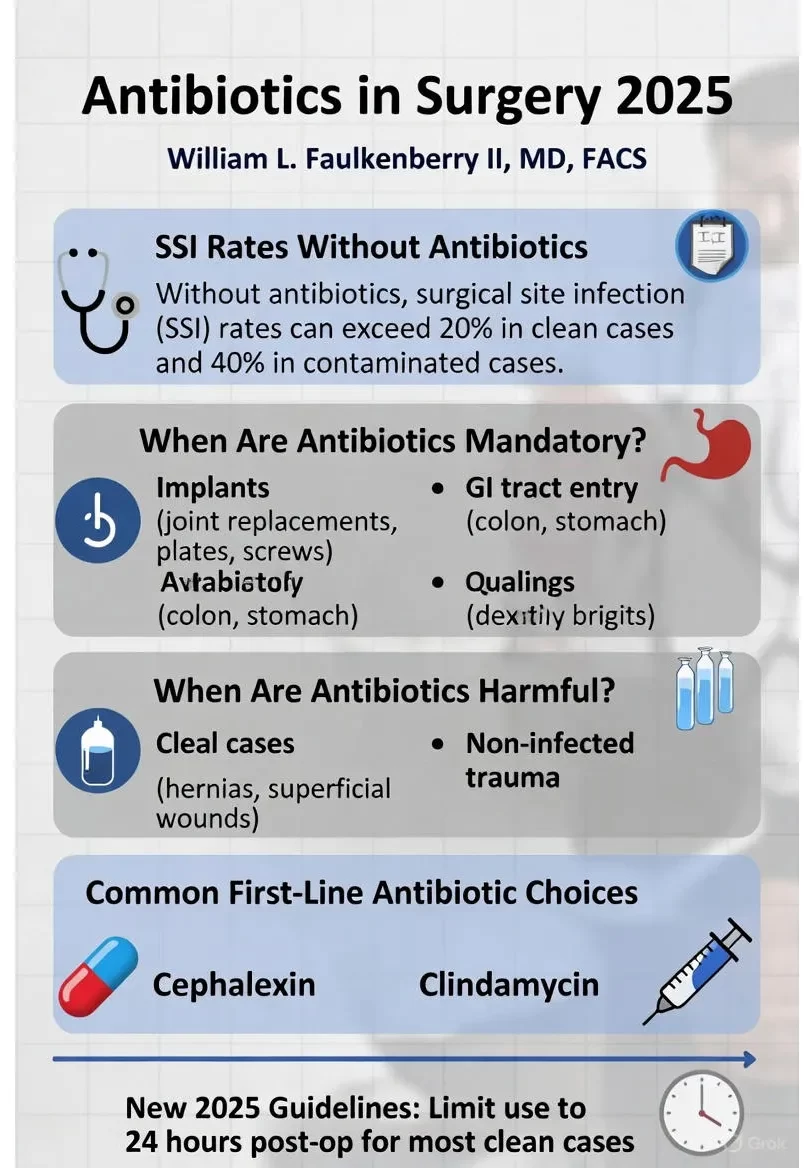 The 2025 joint guidelines from the American College of Surgeons, Surgical Infection Society, and Infectious Diseases Society of America maintain clear, non-negotiable indications for perioperative antibiotic prophylaxis. These indications are supported by Level 1 evidence and have remained unchanged despite the overall trend toward shorter courses.
Prophylaxis is mandatory in every clean-contaminated (Class II) procedure and in every clean procedure that involves implantation of prosthetic material or foreign bodies. The highest-risk operations include colorectal resection, biliary tract surgery with stones or obstruction, gastrectomy, pancreaticoduodenectomy, head-and-neck cancer resection with mucosal breach, and hysterectomy. In these cases, a single appropriately chosen preoperative dose reduces SSI risk by 60–80 % a benefit so large that withholding antibiotics is now considered a deviation from the standard of care.
The same requirement applies to joint arthroplasty, cardiac valve replacement, vascular grafts (synthetic or biologic), pacemakers, spinal instrumentation, and breast implants. A 2024 meta-analysis of over 180 000 prosthetic joint procedures showed that omitting preoperative cefazolin increased deep infection risk from 0.9 % to 5.8 % at one year.
Certain patient-level factors independently mandate prophylaxis even in otherwise clean cases: uncontrolled diabetes (HbA1c >8.5 %), active immunosuppressive therapy, BMI ≥40, ASA score ≥3, and chronic kidney disease stage 4-5.
Exact timing (60–120 min before incision for most agents, 120 min for vancomycin), weight-based dosing, and intraoperative redosing protocols are covered in detail in the companion article – Preoperative Antibiotic Prophylaxis 2025 – Exact Timing & Redosing Rules
When Postoperative Antibiotics Are Contraindicated and Cause Net Harm
The most dramatic change in 2025 practice has occurred in clean (Class I) procedures without implants. Multiple large randomized trials and national registry data published between 2022 and 2024 conclusively demonstrated that extending antibiotics beyond 24 hours or even giving any postoperative doses provides no reduction in SSI while significantly increasing patient harm.
Common procedures in which postoperative antibiotics are now explicitly not recommended include:
- Elective open or laparoscopic inguinal/femoral hernia repair (with or without mesh)
- Thyroidectomy and parathyroidectomy
- Carpal tunnel release, trigger finger release, and minor hand surgery
- Lumpectomy or simple mastectomy without reconstruction
- Uncomplicated laparoscopic cholecystectomy for symptomatic cholelithiasis
- Skin and soft-tissue excisions, Mohs surgery, and local flap reconstruction
In these settings, continuing cefazolin or switching to oral Keflex after skin closure increases Clostridioides difficile risk fourfold and acute kidney injury by 38 % in patients over 65 years, without lowering the already low (<2 %) SSI rate.
Most Commonly Used First-Line Surgical Prophylactic Antibiotics in the United States 2025
| Antibiotic | Primary Spectrum | Typical Prophylactic Dose (IV) | When Preferred in 2025 | Cost per Dose (US hospital 2025) |
|---|---|---|---|---|
| Cefazolin | Excellent Gram (+), moderate Gram (–) | 2 g (<120 kg); 3 g (≥120 kg) | Clean procedures, orthopedics, cardiovascular, most general surgery | $4–$9 |
| Cefoxitin | Gram (+), Gram (–), anaerobes | 2 g | Colorectal, appendectomy, gynecologic | $18–$26 |
| Amoxicillin-Clavulanate (Augmentin) | Broad: Gram (+), Gram (–), anaerobes, β-lactamase resistance | 2 g / 200 mg | Biliary, upper GI, mixed flora expected | $35–$48 |
| Vancomycin + Cefazolin | MRSA + standard coverage | Vancomycin 15–20 mg/kg + Cefazolin 2–3 g | Known MRSA colonization or high-prevalence units | $45–$70 combined |
| Clindamycin + alternative | Gram (+), anaerobes (β-lactam allergy) | Clindamycin 900 mg ± gentamicin/cipro | True β-lactam allergy | $15–$30 |
Detailed head-to-head comparison of Amoxicillin versus Augmentin in surgical prophylaxis is presented in Article – Amoxicillin vs Augmentin in Surgery – Complete 2025 Comparison]
When oral step-down or outpatient continuation is considered, Keflex (cephalexin) remains the most frequently chosen agent; its current role is examined in Article – Keflex in Modern Surgical Practice – When It Still Wins
Emerging Resistance Trends That Are Forcing the 2025 Restrictive Approach
The CDC’s 2025 Antibiotic Resistance Threats Report upgraded surgical-site pathogens to Urgent status for the first time. Key developments driving the new restrictive guidelines:
- Methicillin-resistant Staphylococcus aureus (MRSA) now accounts for 48 % of all deep SSI after cardiothoracic and orthopedic implant surgery (up from 34 % in 2018).
- Extended-spectrum β-lactamase (ESBL) Enterobacterales in colorectal SSI rose from 9 % to 27 % between 2020 and 2024.
- Carbapenem-resistant Acinetobacter and Pseudomonas are increasingly recovered from vascular graft and trauma-related infections, often within 72 hours of unnecessary prolonged prophylaxis.
Every additional day of broad-spectrum antibiotics beyond evidence-based duration increases the odds of isolating an MDRO from the surgical wound by 8–12 % (JAMA Surgery, January 2025). This direct link between over-treatment and resistance is why the Surgical Infection Society now states:
“The most powerful antibiotic stewardship intervention a surgeon can perform is simply stopping the drug when guidelines say to stop.”
Real-World Outcomes After Adoption of 2025 Short-Course Protocols
Several large U.S. health systems that fully implemented the new guidelines in January 2025 have already published early outcomes:
- Kaiser Permanente Northern California (n = 41 237 procedures): 31 % absolute reduction in postoperative antibiotic days with no increase in SSI and a 44 % drop in C. difficile cases.
- Mayo Clinic Enterprise: 28 % decrease in acute kidney injury events after clean surgery.
- Veterans Affairs Surgical Quality Improvement Program (VASQIP) preliminary 2025 data: nationwide SSI rate fell from 3.4 % (2023) to 2.9 % despite shorter courses, driven almost entirely by cleaner Class I and II procedures.
These results confirm that less is truly more when antibiotics are used precisely.
Final 2025 Antibiotic Selection Table for Common Surgical Scenarios (U.S. practice)
| Clinical Scenario | First-Line Agent(s) | Duration (2025 Guideline) | Alternative (β-lactam allergy or MRSA risk) | Evidence Level |
|---|---|---|---|---|
| Clean (no implant) | Cefazolin | Single pre-incision dose only | Vancomycin or Clindamycin | 1A |
| Clean with prosthesis/implant | Cefazolin | Pre-op + 24 h post-op max | Vancomycin (± aztreonam or gentamicin) | 1A |
| Colorectal / appendectomy | Cefazolin + Metronidazole or Cefoxitin | Pre-op + 24 h post-op max | Ciprofloxacin + Metronidazole | 1A |
| Biliary / upper GI | Cefazolin or Augmentin | Single pre-incision dose | Levofloxacin + Metronidazole | 1B |
| Vascular graft / lower-extremity bypass | Cefazolin (± Vancomycin if MRSA risk) | Pre-op + 24–48 h post-op | Vancomycin + Piperacillin-tazobactam | 1B |
| Dirty / established infection | Piperacillin-tazobactam or Carbapenem | 4–7 days or until source control | Meropenem + Vancomycin (± antifungal) | 1A |
Full postoperative duration evidence and high-risk extensions are explored in Article – Postoperative Antibiotic Therapy 2025 – How Many Days Are Actually Needed
Key Take-Home Messages for Surgeons and Patients in 2025
- One correctly timed preoperative dose prevents more infections than seven days of postoperative antibiotics ever could.
- In clean surgery without implants, antibiotics after skin closure are obsolete and harmful.
- Duration beyond 24–48 hours is justified only by proven contamination or ongoing infection.
- Antibiotic stewardship in the operating room is now a core patient-safety metric for hospital accreditation, reimbursement, and public reporting.
Frequently Asked Questions (FAQ)
Do I need antibiotics after surgery in 2025?
In most clean operations (hernia repair, thyroidectomy, carpal tunnel, lumpectomy, laparoscopic cholecystectomy) – no. Current U.S. guidelines recommend only a single dose before incision and nothing after skin closure. Postoperative antibiotics are reserved for contaminated/dirty wounds or proven infection.
How long should surgical antibiotic prophylaxis last in 2025?
For the vast majority of procedures: ≤24 hours total. Many clean and clean-contaminated cases now receive only the preoperative dose with no postoperative continuation. Duration >48 hours is indicated only when there is established infection or ongoing contamination.
Is Keflex (cephalexin) still given after surgery?
Oral Keflex is still commonly used as a 24-hour step-down after orthopedic and vascular implant procedures, but it is no longer recommended after routine clean general-surgery operations.
When are antibiotics mandatory before surgery?
Always when a prosthetic implant or graft is placed and in every clean-contaminated case (colorectal, biliary, gastroduodenal, gynecologic with mucosal breach). Also mandatory in high-risk patients (diabetes HbA1c >8.5 %, immunosuppression, BMI ≥40).
Can I refuse preoperative antibiotics?
In procedures where prophylaxis is Level 1A evidence (joint replacement, colorectal resection, vascular grafts), refusal significantly increases the risk of deep infection and is generally not recommended. Your surgeon will discuss individualized risks and benefits.
Sources
- Surgical Site Infection (SSI) Event Protocol – 2025 Update
- Clinical Practice Guidelines for Antimicrobial Prophylaxis in Surgery (2013, reaffirmed and referenced in 2025 implementations)
- Berríos-Torres SI et al. Centers for Disease Control and Prevention Guideline for the Prevention of Surgical Site Infection
- Global Guidelines for the Prevention of Surgical Site Infection