Surgery is changing faster in the last 10–15 years than it did in the previous 50
Today, patients can receive treatment for complex vascular disease, abdominal problems, and even life-threatening aneurysms using approaches that involve only small incisions, advanced imaging, and computer-assisted control. This is not science fiction or a distant promise. It is the daily reality of modern surgery in Fishersville, Virginia.
Three major forces drive this transformation:
- Endovascular technology: treating blood vessels from the inside, without the need for large open incisions.
- Robotic-assisted surgery: using robotic platforms for extreme precision inside the abdomen and other anatomically difficult areas.
- Advanced navigation and visualization: using 3D guidance systems and high-resolution imaging to make surgery safer and more predictable.
At Shenandoah Valley Surgical Associates (SVSA) in Fishersville, VA, these tools are actively used in patient care. The goal is consistent: safer procedures, shorter recovery, and better long-term outcomes for both vascular and general surgery patients. As we move toward 2030, these methods will only become more refined, more personalized, and more widely available.
Endovascular Methods and Their Advantages
Endovascular surgery is one of the most important developments in vascular innovation. The basic idea is simple: instead of opening the body to reach an artery or vein, the surgeon enters the blood vessel through a very small puncture, usually in the groin or wrist. Through this access point, tiny instruments, wires, catheters, balloons, and stents are guided to the area that needs repair.
This technique relies on live imaging. Surgeons view the inside of the vessels on monitors in real time using fluoroscopy (X-ray guidance) and sometimes intravascular ultrasound. That means they can see exactly where they are working, down to a few millimeters, without needing to physically expose the vessel with an incision.
Why this matters to patients
- Minimal incision
Traditional open vascular surgery often requires a long cut to expose an artery. Endovascular procedures typically require only a puncture site the size of a pencil tip. This means less tissue trauma. - Lower risk of wound complications
Because there is no large open incision, there is generally less bleeding, lower infection risk, and better cosmetic results. This is especially important in older patients, smokers, people with diabetes, and patients with poor circulation, who may not heal well after large incisions. - Shorter hospital stay
Many endovascular repairs are performed as same-day or overnight procedures. Patients often return home in 24–48 hours, instead of staying in the hospital for a week or longer. - Faster functional recovery
Patients are usually able to walk, eat, and carry out basic daily activities much sooner than after open surgery. For individuals with peripheral artery disease (PAD), this faster recovery means improved mobility and less time away from work or rehabilitation. - High precision and planning
Modern endovascular technology uses advanced preoperative imaging such as CT angiography. Surgeons can map the vascular system in detail before the procedure and then carry out that plan with image guidance, reducing variability and uncertainty during the case.
Clinical applications of endovascular surgery
- Aneurysm repair
Abdominal aortic aneurysms (AAA) and thoracic aortic aneurysms can often be treated using stent grafts placed inside the aorta. Instead of sewing in a graft through an abdominal or chest incision, the surgeon deploys a graft from inside the vessel to seal off the weakened aneurysm wall. This approach is called EVAR (Endovascular Aneurysm Repair) for the abdominal aorta and TEVAR (Thoracic Endovascular Aortic Repair) for the thoracic aorta. - Peripheral artery disease (PAD)
When arteries in the legs are narrowed or blocked, patients can develop pain with walking, non-healing ulcers, or limb-threatening ischemia. Endovascular treatment may include balloon angioplasty (widening the artery with a balloon), atherectomy (removing plaque), or stent placement (propping the artery open). These techniques can restore blood flow while avoiding open bypass in many cases. - Carotid artery stenosis
In select patients, carotid stenting provides a minimally invasive alternative to open carotid endarterectomy. The goal is the same: to reduce stroke risk by improving blood flow to the brain. - Venous disease
Chronic venous insufficiency and varicose veins can be managed using catheter-based closure techniques. Instead of removing a diseased vein surgically, the vein can be sealed internally with heat or adhesive, redirecting blood into healthier pathways.
These approaches have become standard of care in high-quality vascular programs. For patients in communities like Fishersville, access to this level of care locally means they do not need to travel to a distant academic center just to receive state-of-the-art treatment.
Robotic and Navigation Systems
If endovascular surgery represents a revolution inside the blood vessels, then robotic-assisted surgery represents a revolution inside the abdomen and soft tissues.
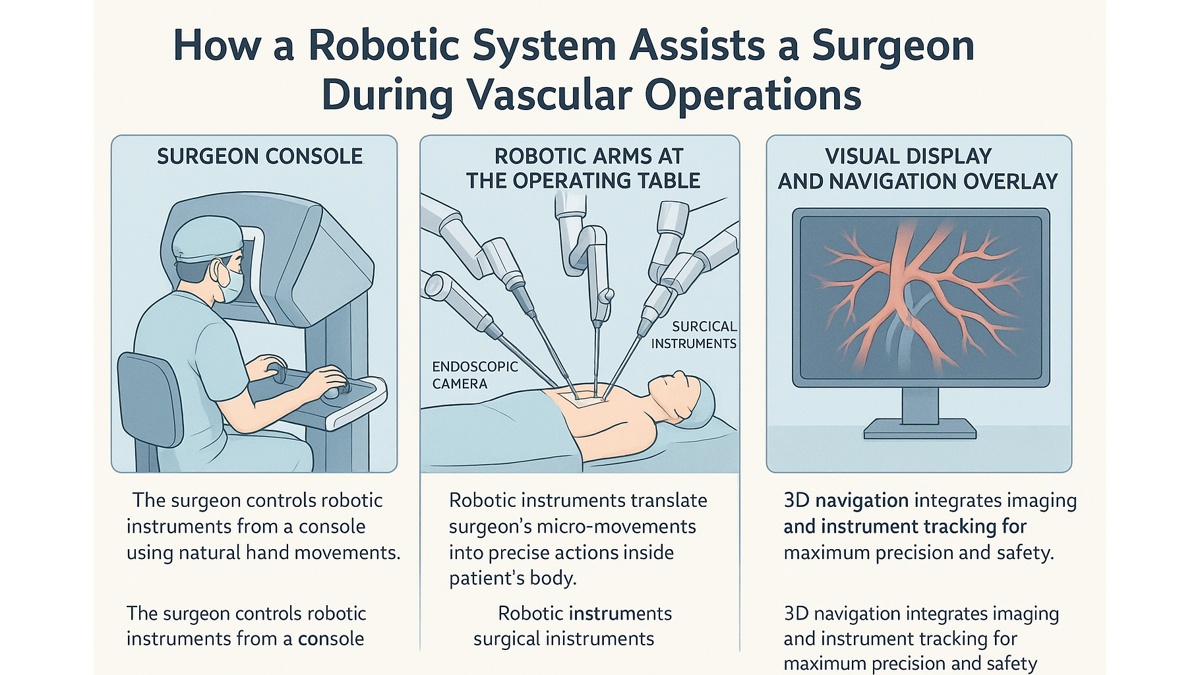
Robotic surgery does not mean that a machine operates independently. The surgeon is always in control. The robotic platform serves as an advanced interface that improves what the surgeon’s hands and eyes can do. A well-known example is the da Vinci Surgical System, which is widely used in general surgery, colorectal surgery, hernia repair, and other abdominal procedures.
How robotic-assisted surgery works in practice
- Small ports are placed instead of one large incision.
Instead of opening the abdomen with a long cut, the surgeon places several small ports (typically 5–12 mm each). Through these ports, robotic instruments and a high-definition camera are inserted. - Enhanced visualization.
The robotic camera provides a magnified, three-dimensional view of internal structures. This level of detail helps the surgeon clearly distinguish critical anatomy such as blood vessels, nerves, bile ducts, and surrounding soft tissue. - Wristed instruments.
Robotic instruments can bend and rotate in ways that exceed normal human wrist movement. This allows for precise dissection, suturing, and reconstruction in tight spaces. - Tremor filtration and motion scaling.
The robotic system can filter the natural small tremor in human hands and can scale large hand movements down to tiny instrument movements. That level of stability is especially valuable near delicate blood vessels or critical structures in the abdomen.
Clinical areas where robotic-assisted surgery is frequently used
- Gallbladder removal
- Complex hernia repair and abdominal wall reconstruction
- Colon and rectal surgery
- Certain vascular exposures and hybrid vascular procedures that combine open and endovascular components
In the context of vascular innovation, robotic platforms are increasingly paired with advanced 3D navigation. Navigation systems allow the surgical team to plan and track each step using preoperative CT or MRI imaging, then confirm instrument position in real time during the operation. This reduces guesswork, protects nearby organs, and supports safer dissection around major vessels.
For patients in Virginia, robotic surgery offers several practical advantages: smaller incisions, less postoperative pain, shorter hospitalization, and quicker return to normal activity. These benefits are especially meaningful for patients with jobs that require movement, patients who cannot afford long downtime, and older adults who may not tolerate traditional open surgery well.
Access to advanced surgical care is no longer limited to major metropolitan centers. Local availability of endovascular and robotic technologies in communities like Fishersville ensures equitable, high-quality treatment close to home.
How Technologies Reduce the Risk of Complications
The main purpose of modern surgical technologies is to increase precision, minimize tissue trauma, and reduce postoperative risks. In vascular and general surgery, this has led to dramatic decreases in complications such as infection, blood loss, and long-term vessel failure.
Precision and Control
Robotic and endovascular systems translate the surgeon’s movements into exact micro-actions. This eliminates unintended tremors and helps avoid injury to nearby structures such as nerves and arteries.
Minimally Invasive Access
Smaller incisions and catheter-based interventions reduce exposure of internal tissues to the external environment. This directly lowers infection risk and postoperative pain.
Enhanced Visualization
High-definition, 3D imaging and intraoperative fluoroscopy allow for continuous monitoring of the operative field. Surgeons can view the anatomy in real time, identify complications early, and take corrective action immediately.
Predictive Planning and Data Integration
Before entering the operating room, the procedure is often simulated on a 3D digital model created from a CT scan. Artificial intelligence tools assist in measuring vessel diameters and predicting stent placement outcomes. These steps prevent technical complications and improve long-term graft durability.
Improved Recovery and Long-Term Outcomes
Smaller incisions mean less physiological stress, lower pain medication requirements, and fewer wound problems. Many vascular patients can now return to normal activity within a week after surgery.
Innovations Used at SVSA
At Shenandoah Valley Surgical Associates (SVSA) in Fishersville, Virginia, surgeons incorporate these technologies into everyday clinical care. The practice focuses on both vascular and general surgery, using minimally invasive and robotic systems supported by advanced imaging.
Endovascular Suite
SVSA’s hybrid operating room integrates real-time angiography, intravascular ultrasound, and 3D mapping. This enables precise endovascular repairs, such as aneurysm exclusion or peripheral artery recanalization, all in one setting.
Robotic-Assisted Surgery
Robotic surgery at SVSA enhances the surgeon’s dexterity and accuracy in complex abdominal procedures. The combination of small access ports, magnified 3D vision, and wristed instruments results in minimal tissue trauma and faster recovery.
3D Navigation and Hybrid Operations
3D navigation overlays CT images onto the live surgical view, allowing surgeons to see exactly where their instruments are at every moment. This is particularly important in vascular reconstructions where millimeters matter.
Patient-Centered Benefits
These technologies minimize blood loss, shorten anesthesia time, and reduce the likelihood of reintervention. SVSA’s approach ensures that innovation is always directed toward improving patient safety and comfort.
Technological integration transforms surgical risk from an unavoidable burden into a manageable variable. Through the use of hybrid operating environments and AI-based planning, SVSA delivers safer, more predictable outcomes for every patient.
Table: Modern Surgical Technologies and Their Applications
| Technology | Advantages | Application |
|---|---|---|
| Endovascular Surgery | Minimal incision, reduced trauma | Aneurysm repair, PAD management |
| Robot-Assisted Operations | Precision, stability, and 3D vision | Abdominal, pelvic, and hybrid surgeries |
| 3D Navigation Systems | Real-time instrument tracking | Complex vascular and reconstructive cases |
| Intravascular Ultrasound (IVUS) | Internal vessel imaging | Stent placement, plaque characterization |
| Hybrid Operating Rooms | Seamless imaging and intervention | Combined open and endovascular cases |
| AI-Based Planning Software | Predictive modeling and risk reduction | Preoperative simulation and outcome review |
Perspectives on the Future of Surgery Toward 2030
The next five years are expected to bring a new wave of transformation to vascular and general surgery
Innovations that were once limited to large research hospitals are now becoming available in regional and community centers such as SVSA in Fishersville, Virginia. By 2030, several technological trends are likely to define the standard of surgical care.
Artificial Intelligence and Predictive Analytics
AI-assisted planning and intraoperative analytics will become central to surgery. Algorithms will help surgeons anticipate anatomical variations, calculate blood flow patterns, and predict postoperative complications before they occur. Decision support systems will analyze live data during operations to guide safer, faster, and more accurate interventions.
Personalized Vascular Treatment
With the integration of genomics and bioengineering, vascular care will move toward customized implants and stents designed specifically for each patient’s anatomy and tissue response. 3D printing technologies will allow patient-specific grafts and endovascular devices to be created within hours, improving long-term outcomes and reducing rejection risks.
Remote and Telementored Surgery
As broadband connectivity and secure networks advance, remote robotic surgery will become possible on a broader scale. Surgeons may supervise or assist complex operations in rural areas through telepresence systems, extending expert-level care to patients far from major hospitals. This development will be especially impactful in regions like the Shenandoah Valley, where access to specialized vascular expertise is limited.
Enhanced Imaging and Augmented Reality (AR)
Augmented reality overlays will project vessel maps, organ outlines, and real-time physiological data directly onto the surgeon’s visual field. Combined with robotic navigation, AR will help avoid critical structures, shorten procedure times, and improve accuracy in complex reconstructions.
Regenerative and Biologic Surgery
Regenerative medicine will increasingly complement surgical treatment. Stem-cell-based vascular grafts and bioengineered tissues will allow the repair of arteries, veins, and soft tissue with living, self-healing materials. These biologic solutions will reduce dependence on synthetic grafts and lower long-term complication rates.
The integration of all these technologies points to a future where surgery becomes less invasive, more personalized, and far safer. For patients, that means fewer hospital stays, faster recovery, and a better quality of life after treatment.
For surgeons, it means that the role of technology will shift from being a helpful tool to an essential partner in achieving optimal outcomes. The future of surgery in communities like Fishersville hinges on access to regenerative therapies and telementored platforms that bridge geographic and clinical gaps.
Frequently Asked Questions (FAQ)
Are robotic surgeries safe?
Yes. The surgeon controls the robot entirely. The system improves accuracy and reduces the chance of complications.
How is endovascular surgery better than open surgery?
It requires only a small puncture, causes less pain, and allows faster recovery with fewer infections.
How long does recovery take?
Most patients return to light activity within a few days and fully recover within one to two weeks.
Are these modern methods more expensive?
Not necessarily. Shorter hospital stays and fewer complications often balance or reduce total costs.
Are these technologies available at SVSA?
Yes. SVSA in Fishersville offers robotic, endovascular, and hybrid procedures using the latest systems.
Patients in the Shenandoah Valley now have local access to world-class surgical innovation. With services ranging from endovascular aneurysm repair to robotic-assisted abdominal surgery, SVSA ensures advanced care without the need to travel to distant urban centers.
Author:
Dr. Charles D. Goff, MD, FACS

Sources
- Society for Vascular Surgery – Clinical Practice Guidelines and Reporting Standards
- NIH/NIBIB – Robotic and Bionic Medical Devices
- PMC – Robotic Surgery: A Comprehensive Review of the Literature and …
- MedlinePlus – Robotic Surgery (patient-friendly overview)
- PMC – Clinical applications of artificial intelligence in robotic surgery